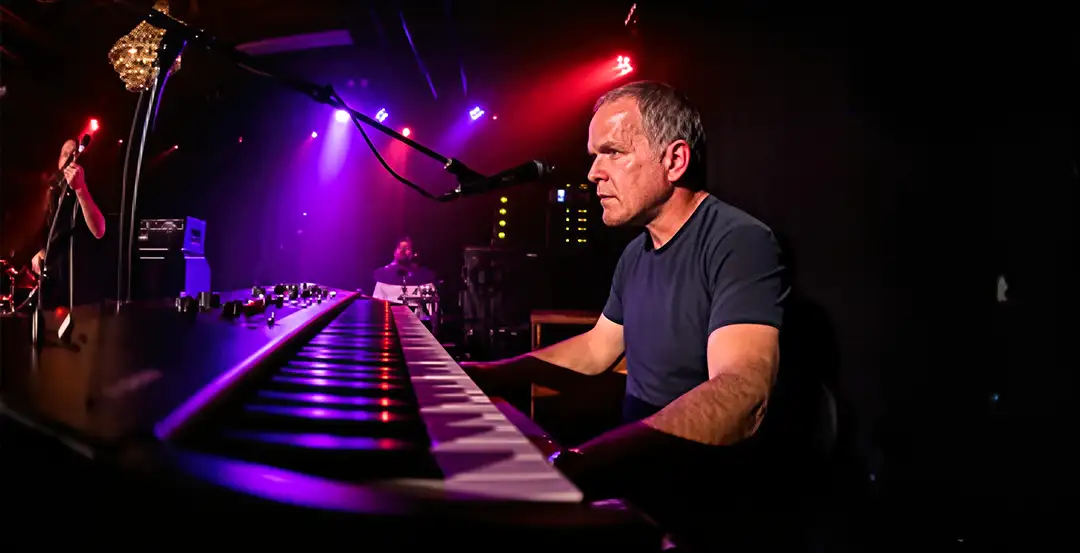
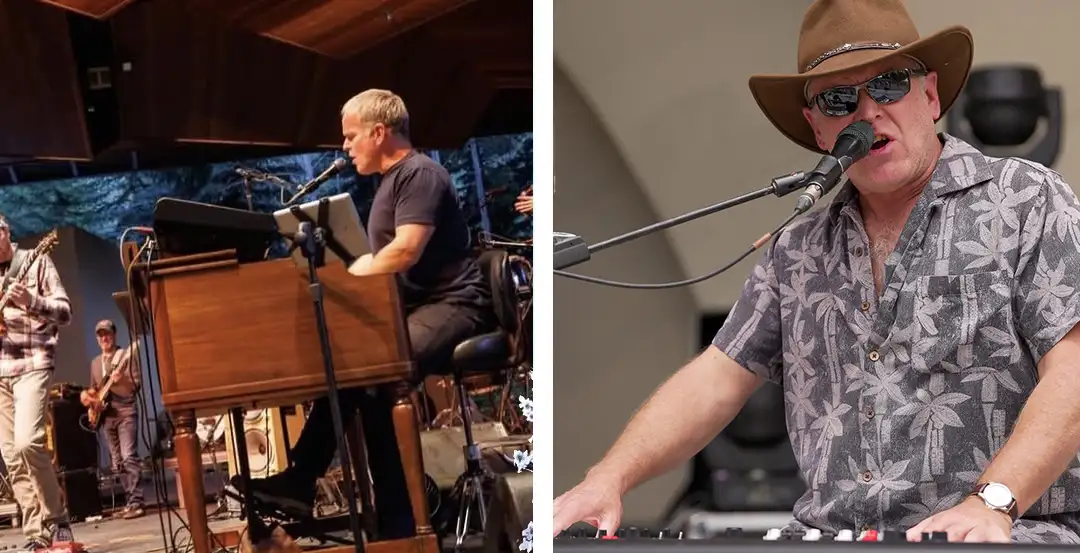
In this Community Spotlight, Bill sits down with Gary Gutierrez to talk about the teacher who changed the course of his musical life, the bands and musicians who shaped him, 25 years on the road, and the lessons that have kept him making music all these years.
Q & A with Bill McKay
Gary: I actually knew you well before I knew you knew me. I saw you with Leftover Salmon for a lot of Halloweens at the Fillmore Auditorium. I know you sing and you play piano, so what came first?
Bill: Singing did, really. I actually started singing professionally when I was around six. I also started playing piano around the same age, but I was a male soprano in a church choir where I grew up in New York.
I was raised Catholic, but this was the Episcopalian church, and they had the only paying church choir in town. They actually paid the members for rehearsals and services on Sundays. I think at the time I was getting like $3.25 an hour, which was minimum wage.
That was sort of my first professional gig, singing in this church choir. I stayed in that choir as my voice changed. I moved from soprano briefly to alto and then down to bass and kind of skipped baritone.
So yes, I’ve been a singer for my entire life.
Gary: What did your path look like as you started learning music and piano more seriously?
Bill: Singing-wise, I was very lucky to have this great choir director, and I learned how to read music early on. I learned how to sing my way through these four-part and five-part harmonies we were doing in church music.
With piano, I started taking lessons around six or seven or eight. I learned classical, like a lot of kids do at an early age. I started with the same basic stuff, and then for a long time I was playing classical music and sonatas.
The greatest benefit of that was learning how to read staff music and learning how to control my fingering and technique.
But then I got to probably 11, 12, 13, somewhere in there, and I was losing focus and was on the verge of quitting. I would show up to lessons without having done my work, without having worked on the sonata or whatever I was supposed to be learning that week.
And this young woman who was my teacher recognized it and asked me, “What do you listen to at home?”
Gary: And what were you listening to?
Bill: My older brother, John McKay, was a musician, and he had all these books around the house. The Beatles, the Grateful Dead, Crosby, Stills & Nash, John Prine, Neil Young.
I was going through all my older siblings’ record collections on a daily basis, and I was fascinated by all this music. I would sit there and try to sing the harmony parts on Crosby, Stills & Nash records. I would try to pick apart the harmony parts vocally on Beatles records.
So when she asked me what I listened to, I told her. And she said, “Well, why don’t you bring in some of those books you’re talking about?”
I think a Neil Young book was one of them. A Grateful Dead book might have been one of them too.
And she shifted gears completely. She said, “Okay, we’re going to teach you how to play this music.”
She showed me how to transfer the guitar chords to the piano, and then she shifted everything much more in depth into theory training and ear training. She taught me jazz theory. She would have me sit with my back to the piano and pick out the chord she was playing, the inversion she was playing, the scale she was playing.
Once I realized that I could play music that I liked, it was off to the races.
Everything in my life developed from there. It all flowed from there. It was a magical thing for me to understand that I could sing and play this music that I was starting to be really into.
Gary: You have a theory about that age being a really important turning point for young musicians?
Bill: I do. When kids get to be 11, 12, 13 years old, a lot of things start happening to them. They’re changing physiologically and emotionally, and they’re becoming interested in other things in their lives.
There are kids who continue to be inspired by classical music, and some go on to be brilliant classical players throughout their lives. But for a lot of kids, you’re suddenly listening to completely different music than what you’re being asked to play in your lessons.
I think classical music is the best stepping stone for any musician to learn. I really do. It teaches you how to read, and it teaches you fundamental physical aspects of technique and how to hold your hands. Those are very important things.
But then there comes this crucial moment. You talk to so many people who say, “Oh, I took piano lessons when I was a kid, and I quit.” I’ll ask, “What age did you quit?” And it’s 11, 12, 13, right in there.
By some stroke of amazement, I was blessed with this young woman teacher who recognized what was happening to me and took action because she recognized I had a gift to play. She showed me how I could apply my talents to popular music that I liked.
Becoming aware that I could actually play the music that I liked, that my friends liked, that the older kids liked, enabled me to become more a part of the scene through the ability to play music.
Gary: Today you’re the hired musician I seem to see everywhere. I’ll hire a band, and suddenly Bill McKay is on stage. What has allowed you to become that kind of working musician and what advice would you give to young musicians?
Bill: I’m very blessed in that regard, and honestly, it comes from a lifetime of hard work. It comes from reliability and being willing and interested in playing lots of different kinds of gigs.
I’m not necessarily in as many bands, as I am a musician for hire. I get asked to do a lot of work.
For a beginning piano student, I have some pretty typical answers. You have to learn technique. You have to learn how to hold your hands. You have to learn conservation of energy, which is one of the fundamental things I teach. You need the essential crossover techniques with your fingers, how to hold your body, how to hold your hands.
You have to learn scales. You have to learn how to read, even if it’s really basic reading. You have to know where the notes are on the staff.
I can’t sit down right now and sight-read a sonata. I’d be plunking through it with one finger at a time. But I know what’s going on on that piece of paper. If I’m challenged with a particular piece of music, I’ll go to the staff. I’ll read it and work on it really hard so I can understand exactly where it lays on the piano.
But the thing that really propelled me, and has allowed me to do what I do, is ear training and theory training.
When you have ear training at an early age like I did, it opens up your ears. I’ve been able to sit in with dozens and dozens of bands because I learned at an early age how notes relate to each other. When I hear a chord, a chord progression, an inversion or a harmony, I recognize it because it’s been part of my entire upbringing.
Gary: So once you’ve learned the notes, what takes someone from being able to play an instrument to really being able to play with other musicians?
Bill: Listening.
We musicians don’t listen to music the same way anymore. We’re constantly analyzing it, no matter what it is. But we’re still able to listen to music and enjoy it from our heart too.
Fundamentally, listening is more important than playing.
When you’re on stage with any number of people, listening to what’s going on around you is the fundamental skill you need to develop. That will lead you to be able to place your notes in proper positions amongst other players.
And then, as you get into what I do for a living, there are other things that have nothing to do with music, such as reliability.
Gary: Let’s talk about that. You can have all the skills, but what does it take to actually build a career and keep getting the call?
Bill: I’ve been very lucky throughout my life to get in with other great musicians. I think playing with more experienced, older and more talented musicians is a key thing for people to do.
I never underestimate the power of playing with people, and never underestimate other people’s experience.
I consciously searched that out. As a younger musician, I always wanted to play with older and more experienced musicians in order to develop my own craft.
Reliability, in my opinion, is one of the most important things. That’s not just showing up on time. It’s doing the things aside from the gig that make you reliable. It’s working on the material at home. It’s listening to the material. It’s listening to the people at the gig. It’s not throwing tantrums and throwing fits. It’s not overbooking yourself. It’s all of those things that can make you not get the call back.
I’ve been fired plenty of times, which I think is a good learning experience. I’ve been passed over and neglected many times. A lot of it has to do with looking at yourself in the mirror and recognizing the behavior you might be displaying that’s a turnoff to getting hired.
Gary: I think there’s an important distinction there. When you’re coming to these shows, you’re coming to work. You’ve got a responsibility on stage. You’re accountable from the moment you get there.
Bill: Absolutely.
Gary: Your career has covered an incredible amount of ground. Let’s go back to the early ’90s. What were some of those formative bands and musicians for you?
Bill: I’m very proud of the early ’90s when I was fresh out of college. I played with a band called Band Du Jour out of Boulder, and that’s where I cut my teeth on touring.
We went to Japan and South Korea, and we toured all over the country. This was early touring without cell phones, with paper maps and payphones.
Johnny O was in Band Du Jour, and he still plays in the Boulder music scene. Dave Weisbart, Danny Schultz and Sherry Jackson were in the band too. I’m very proud of those five years.
Then I got a call and joined The Derek Trucks Band, an early version of the band, from about 1995 to 2000. I moved to Atlanta for a few of those years, although I always had one foot in Colorado the whole time.
I’ve always been shadowed by Niwot’s curse, never able to escape Colorado.
I played in The Derek Trucks Band with Derek Trucks, Todd Smallie, my dear friends Yonrico Scott, and Kofi Burbridge.
I became very entrenched in the Atlanta music scene with Colonel Bruce Hampton. It was actually Jimmy Herring and Colonel Bruce who referred me to a young Derek Trucks at that time. I had met those guys through Aquarium Rescue Unit while Band Du Jour was touring.
I got to know Jeff Sipe, Oteil Burbridge, Kofi Burbridge, Jimmy Herring, and all those great musicians during my years in Atlanta. A lot of musicians I’ll cherish for my whole life.
Gary: And after The Derek Trucks Band, Colorado pulled you back.
Bill: When I left that band, I was kind of floating aimlessly in Atlanta, and I got a call from Leftover Salmon’s tour manager.
A couple of those guys were old friends of mine from the Band Du Jour days, Mark Vann and Vince Herman most importantly, and they asked me to come back to Colorado and play with Leftover Salmon.
I gladly returned. I was missing Colorado.
I played with Leftover Salmon for 11 years, toured all over the country and made a couple of records with them. I’m very proud of the work I did with Leftover Salmon.
I’m also really proud of helping the band through the years that Mark Vann got sick and then unfortunately passed away.
I also got to play with some of my all-time heroes during those years. The guys from Little Feat, including Bill Payne, who I still communicate with, and all of the great bluegrass players associated with that jamgrass world.
It taught me a lot about music I wasn’t as familiar with, especially bluegrass and Cajun music. It increased my ability as a musician to play all these different styles as a keyboard player.
Those were formative years of my life with Band Du Jour, The Derek Trucks Band and Leftover Salmon, all very different styles of music that I really enjoyed.
Gary: The Derek Trucks years alone must have required you to move between a huge range of styles.
Bill: We were playing jazz fusion. We were playing blues, but we were writing songs. We were playing standards by Miles Davis and Wayne Shorter, all sorts of jazz, and funk.
That’s part of what those years gave me. All of these different styles became part of what I could do.
Gary: And your musical life certainly didn’t stop with those three bands.
Bill: No, and that only takes me up to about 15 years ago!
I proceeded to play with Coral Creek and my good friend Chris Thompson for about five years. We recorded a couple records, and I wrote what I consider to be some of my best songs during those years.
Throughout all these years, I’ve always had my own band with different members, and I’ve written a lot of solo piano. I have a solo piano record that’s been out for over 10 years.
More recently, I released a single called “Girl in the Moon.” It’s a piano and a string quartet, and the entire string quartet was played by my friend Enion Pelta-Tiller. She played all four parts and she’s an incredibly talented and really magical musician.
Gary: And somehow, even with all of that history, you’re still the person who can show up in two different bands at the same festival.
Bill: Absolutely.
I played three gigs last Saturday. I don’t know what to do with myself when I’m not playing.
A good example is The Other Brothers, which is an Allman Brothers tribute band that I have, by default, become sort of the bandleader and primary booker for. It’s a powerhouse band of Allman Brothers music.
Then my friend Andrew McConathy might ask me to stick around and play a Drunken Hearts set. That’s not a band I’m in regularly, but they’re all friends of mine.
Gary: And then there’s Steely Dead. I’ve seen you sitting in when they want a larger, fuller show.
Bill: I’m actually an original member of Steely Dead. I was in the founding of Steely Dead.
There’s another brilliant keyboard player, Dylan Teifer, in Steely Dead. But I’m an original member, and I’m still in the fold. They pull me back in.
Gary: After all those years of touring and all the different projects you’ve been part of, you still seem genuinely excited just to get on stage and play.
Bill: I am. I’d absolutely rather be playing than not playing.
I played three gigs last Saturday. I don’t know what to do with myself when I’m not playing.
I’ve been very lucky throughout my life to get in with other great musicians, and I’m very blessed that I still get asked to do a lot of work. It comes from a lifetime of hard work, reliability, and being willing and interested in playing lots of different kinds of gigs.
At the end of the day, I just love to play.
Learn More and Get Involved
Bill McKay Music: Follow Bill’s music, performances, original releases, and upcoming shows.
Band Du Jour: The Boulder band where Bill “cut his teeth on touring,” traveling across the United States as well as Japan and South Korea.
The Derek Trucks Band: Five formative years of jazz, blues, funk, songwriting, improvisation, and life in the Atlanta music scene.
Leftover Salmon: More than a decade of touring, recording, and exploring bluegrass, Cajun music, jamgrass, and beyond.
Coral Creek: Colorado Americana and newgrass featuring original music from Chris Thompson and Bill McKay.
Steely Dead: A fusion of Steely Dan and Grateful Dead music, with Bill among the project’s original members.
The Other Brothers: A powerhouse Colorado ensemble celebrating the music of the Allman Brothers.
The Lesson Studio: Performance-based music education in Boulder and beyond.
Stephen Oskay, Bringing Music and Community to Downtown Boulder
If you have spent much time in Boulder, chances are you have experienced something Stephen Oskay helped put together....
Mikaela Gregg and the Growing Event Scene in Superior, Colorado
In just a few short years, the Town of Superior has transformed its community events calendar from a handful of annual...
Rebecca Folsom, Songwriter, Performer, and Storyteller
For several decades, Rebecca Folsom has built a career rooted in songwriting, performance, and authentic musical...
Pete Lewis of Muse Performance Space, A Home for Creative Music in Lafayette
Since opening its doors in 2018, Muse Performance Space in Lafayette, Colorado has become one of the most unique live...

Bridget Law, Waldorf Strings Teacher, Performer, and Champion of Musical Joy
For more than two decades, Bridget Law has built a career as a performer, arranger, and recording artist. From fiddle...
Ian Arras, Recording Arts Student, Performer, and The Lesson Studio Alum
Ian Arras is part of a growing generation of musicians building careers through versatility, collaboration, and real...