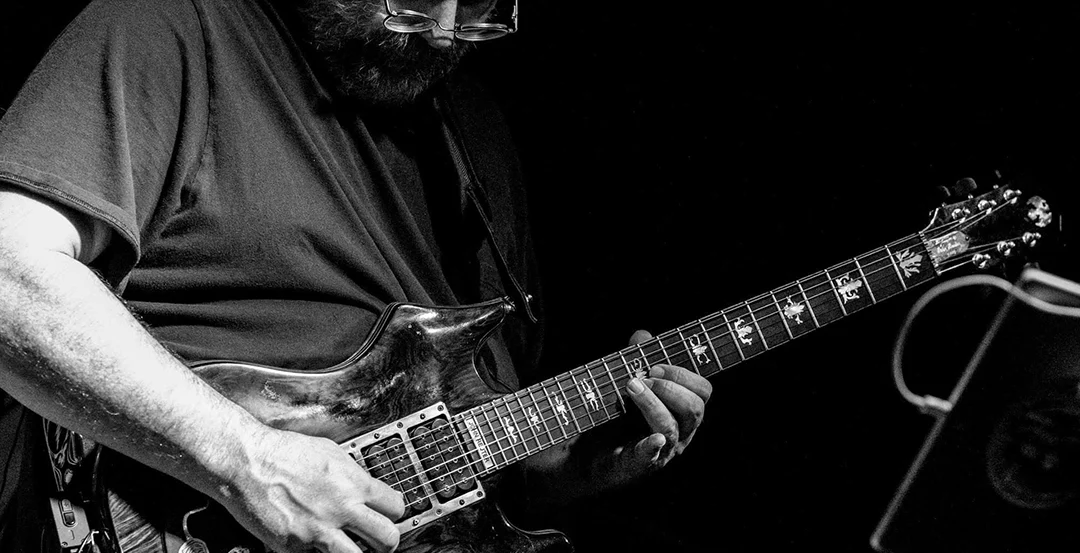
Dave Hebert (AKA Dave A’bear) has spent decades playing guitar, touring the country, and exploring everything from reggae and jazz to the music of the Grateful Dead. Today, he’s known for his work with Steely Dead and his years performing with Melvin Seals and JGB, but his musical journey started with a borrowed acoustic guitar and a love of rock and roll.
In this Community Spotlight, Dave joins Gary Gutierrez of The Lesson Studio to share his musical background, the techniques he recommends for learning Jerry Garcia’s guitar style, and the equipment that can help guitarists get closer to that unmistakable Grateful Dead sound.
Q & A with Dave Hebert (AKA Dave A’bear)
Gary: Before we get into Jerry Garcia and the Grateful Dead, I’d love to hear a little about your background. How did you first get started playing guitar?
Dave: I started playing guitar probably when I was about 13 or 14, and I picked up my dad’s acoustic. My dad was a singer-songwriter, and he would pluck around the house and play our favorite tunes when we were kids, like “Puff the Magic Dragon.”
I grew up listening to my dad play guitar and sing. I remember picking up his Yamaha acoustic and learning chords. It didn’t take long, maybe six months or a few months, before my dad was like, “I think you’re better than me.” My dad was more of a strummer, and I was picking out chords and trying to solo and go for it.
But I wasn’t listening to Willie Nelson or Leon Russell and the stuff my dad listened to a lot. I was listening to more metal. KISS, AC/DC, Eddie Van Halen, Yngwie Malmsteen. That was my thing for a little while. My parents knew they had an issue when all of our lunchboxes and school gear had KISS stuff on them!
Gary: That’s quite a starting point! How did you go from KISS and metal guitar to jazz and improvisation?
Dave: My mom encouraged me to take lessons, and one of the people I studied with was Alan Joseph, a jazz teacher. I would go to his garage when I was a teenager, and he’d show me things. I’d tell him all the music I wanted to learn, and he’d kind of shake his head.
But I started watching his little trio have jam sessions in the garage. I watched them improvise at a pretty formative age, probably 15 or 16 years old. That really was the moment I was like, “Oh, you can do that with the guitar? You can maybe not have to learn a song. You could just get down and watch these dudes.”
From that point, my interest shifted more toward jazz. We were listening to Jaco Pastorius, Jean-Luc Ponty, Frank Zappa, all kinds of different stuff. My musical palette immediately expanded when I was in high school. I also always loved reggae music, and that became a big part of my early playing.
Gary: You grew up here in Colorado, right? How did that lead to your first touring experience?
Dave: I grew up pretty much on the west side of Colorado Springs, in Manitou Springs. It was a pretty magical way of growing up. You could go have your lunch break in Garden of the Gods and then head back. It was really great.
I had a friend whose dad was a reggae touring artist named John Bayley. He played all over Colorado, and he was really popular at the time, probably the mid-’80s.
I went to the Colorado Institute of Art to learn music video production and business. After that, I started touring with John Bailey and the Sons of Zion. John was playing, his son Terrance Bayley was on bass, and I was on guitar. Right out of college, before I was 21, I was playing reggae all over the country. It was really eye-opening and a blast.
I actually missed out on going on Grateful Dead tour because all my buddies were saying, “Oh, you’ve got to come on tour and see Jerry!” And I was like, “I’m busy making a little stipend and going and seeing the country!”
Being able to experience touring at such a young age really planted a seed. It was like, “Oh wow, this is possible.”
Gary: That’s interesting because people know you so well for playing Jerry Garcia’s music now. When did the Grateful Dead finally click for you?
Dave: I wasn’t even actively listening to the Grateful Dead in 1990 or 1991. I knew of them, and I had friends who were really trying to get me into it. Even my music teacher, Miss Paulson, was a Deadhead. I’d go into her office during guitar class, and she’d be playing bootlegs. But it just didn’t really fit for me at the time.
Then, when I was on tour with John Bailey and the Sons of Zion, somebody came up to me after a show and asked, “Do you listen to the Grateful Dead or Jerry Garcia?” I said, “No, I don’t.” They said, “Well, you really should, because you’re already phrasing and quoting in his manner, and the way you approach it.”
That stuck with me. I remember hearing “Fire on the Mountain” on a jukebox and thinking, “Oh yeah, I’ve heard these songs. I just never really listened.”
Then through Shakedown Street in Manitou Springs, Ted Galloway, God rest his soul, was someone who really brought me closer to that music. That’s what started it.
Gary: And eventually that led you to playing with Melvin Seals and JGB. There’s a story floating around that you were one of the first guitarists to step into Jerry’s role. Is that true?
Dave: No, there were other guitar players before me. After playing music in Colorado, I moved to Arizona and joined my first Grateful Dead band, Xtra Ticket. I probably did almost ten years with that band.
Then I got the gig with JGB around 2010. Jerry passed away in 1995, and Melvin Seals had already worked with a roster of musicians. I may have been the fourth or fifth guy.
But I got a good five years in, and that was another really eye-opening experience. Being in that band, doing the touring, learning, putting the work in. I really cherish the years I got to play with Mel.
As far as replacing Jerry, good luck! The music is so powerful. People love it so much.
Gary: And now you’re touring with Steely Dead, which takes two very different but equally complex musical catalogs and puts them together. What makes that work?
Dave: What’s amazing about Steely Dead is that it’s really unlocked our ability to tour around the country. Even though we’re covering material from two different bands, I think we’ve managed to figure out how to maintain some originality and individuality inside the band.
It’s not like, “Hey, just show up and play it like the album.” We really have to work things through, especially with four guys trying to do either of these bands, which have much larger instrumentation than we have.
And one of the weird reasons Steely Dan and the Grateful Dead can meld together is because of some of the modal similarities in their music. It’s been a really interesting musical experience.
How to Play Guitar Like Jerry Garcia: Dave’s Practice Advice
Gary: Let’s get into the practical side. Say I’m a guitarist who knows my way around the instrument, but I really want to learn Jerry Garcia’s style. Are there certain scales, exercises, or techniques that give players the best return for their time?
Dave: I really think the quickest way is through ear training. I do scales, just a major scale, a lot, mostly to keep my fingers warm. But I would say ear training is probably the best way to go for playing Grateful Dead music. What I mean by that is knowing how to play a mode.
Before I ever had music theory, I could play modally over stuff that would be considered the correct modal palette for whatever chord was happening. I know the theory and the mechanics of it now, but back then I was really using what I could hear.
Part of me wishes I’d gone to Berklee College of Music and somebody could have cut out years of trial and error. But another part of me is really happy I went the route I did. I just used what I could hear.
Being able to speak modally on your instrument is really important. Because if you can hear it, you can play it.
Gary: So you’d recommend learning all seven modes?
Dave: Yeah. I would go through the seven modes. I usually practice under a tonic note. Say I’m working with F Lydian. I know that if I play every note in the C major scale, it’s going to work over that.
So instead of thinking of it as playing F Lydian, I can look at it as playing C major. That’s why I practice major scales. I use them over whatever the modal connection is.
Gary: I’ve always told people to learn Mixolydian if they want to play Jerry’s style. The Grateful Dead really live in that sound.
Dave: Yeah. Ionian lives in tunes like “Friend of the Devil” and “The Wheel.” There are definitely places where that palette works. And Mixolydian works across all kinds of their music, especially the more cowboyish and bluesy stuff.
Gary: What about physical exercises? Anything you wish you’d started practicing earlier?
Dave: One of the reasons I’ve decided to do major scale warmups is because, as a guitarist, when I’m riffing in that pentatonic box, I sometimes forget about the pinky. I’m really just playing with three fingers. When I do major scale warmups, my pinky has to be involved all the way through.
And instead of just going up a half step each time, I like to do them in the circle of fifths. I’ll do C major, then G major, then D, then A, then E, then B, and keep going through the circle.
I also come up with different patterns instead of just playing straight up and down. There’s nothing amazingly musical about it, but if I work on that for five minutes before a show, my coordination is already there. I’m not waiting to warm up.
When I practice, I practice to warm up. And then when I go play, I just kind of let it flow through.
Gary: What about improvising? How do you keep a solo from becoming just a bunch of scales?
Dave: Sometimes I’ll catch myself running scales when I’m supposed to be soloing. I’ll realize I know where my fingers go, but it doesn’t really have anything to say. So I’ll stop myself and think, “Okay, stop the run-on sentence. Try to say something.”
What might be going through my mind is: “All right, play something simple. Repeat that. Okay, now embellish that. Okay, now that you’ve embellished that, add an arpeggio.”
Those are the building blocks of how to build out a solo. And one thing I’ve learned from teaching students is that rhythm is incredibly important.
I’ve had students who want to know exactly where to put their fingers. I’ll show them, and then realize I haven’t taught them anything about rhythm. You’ve got to have a little bit of rhythm to accommodate that fingerboard knowledge.
Gary: You also mentioned learning the melody of the song itself. Why is that so important?
Dave: Always learn the melody. Sometimes I put on Grateful Dead backing tracks and just play the melody. I won’t solo. I’ll try to play the vocal melody. That’s where the ear training really comes in.
I’m not a big lick learner. I’m more of a melodic threader. I love to say things with melody. And if you can quote the melody of a tune, that’s a really important skill.
Somebody told me I should do that 30 years ago, and I was like, “Yeah.” And here I am, like, “Yeah, you really should do that!”
Gary: Do you have any resources you recommend to guitarists who are working on this style?
Dave: Definitely. There’s a guy named Jack Devine, and he has a YouTube channel called JackSnax. I could sit down and watch him explain how to solo over “Scarlet Begonias,” something I already know how to do.
But if I watch it intently enough, I’ll walk away with three things. Then I can watch that same video a month later and walk away with something else I didn’t catch the first time. I really enjoy those.
I also use backing tracks. I’ll put on some jazz fusion, throw on some distortion and delay, and just go for it. It’s not necessarily what I’m playing with Steely Dead, but it’s outside my wheelhouse.
I’ll spend 15 or 20 minutes working through something like that, and I tend to come up with new ideas I can take back to Steely Dead.
Gary: Even after all these years, are there still things you’re working to improve?
Dave: Oh yeah. When I sit down and practice, I’ll run over what I call the “musical landmines” in my setlist. Those are the things that maybe one out of ten times I forget, or I screw up.
So when I rehearse, a lot of it is maintenance. It’s finding an area I have trouble with and working on it.
I’m happy with where I am as a guitarist, but there’s definitely a style I wish I was more proficient at, and that’s jazz fusion playing outside the box, that Jimmy Herring kind of thing. I’m always looking at that stuff.
A Jerry Garcia-Inspired Guitar Practice Routine
For guitarists wondering where to begin, Dave’s advice can be organized into a practical daily routine. This is a suggested 30-minute session based on the techniques he discussed, rather than a fixed schedule he personally follows.
Time |
Exercise |
What to focus on |
| 5 minutes | Major scale warmup | Play cleanly, use all four fretting fingers, and keep your pinky involved |
| 5 minutes | Circle of fifths | Move through C, G, D, A, E, B and the remaining keys, varying your scale patterns |
| 5 minutes | Modal ear training | Practice hearing and playing different modes over a sustained note or simple chord progression |
| 5 minutes | Melody practice | Play the vocal melody of a Grateful Dead song on guitar rather than immediately soloing |
| 5 minutes | Build a solo | Start with a simple phrase, repeat it, embellish it, then introduce an arpeggio |
| 5 minutes | Rhythm and problem spots | Work on timing and the passages that consistently give you trouble |
Dave’s other recommendation is to spend time playing acoustic guitar, even if your ultimate goal is electric guitar. He suggests dividing your practice time equally between acoustic and electric to develop finger strength, dexterity, and control.
The lesson running through all of his advice is simple: knowing which notes to play matters, but hearing what you’re playing, developing a melody, and knowing when to leave space matter just as much.
How to Get Jerry Garcia’s Guitar Tone: Dave’s Gear Recommendations
Gary: Let’s talk gear. If somebody wants to start building a Jerry Garcia-inspired guitar rig, but they’re not ready to invest in a huge professional setup, where should they start?
Dave: I’m a big fan of the Fender Stratocaster. So, a Stratocaster and a Fender Deluxe.
I think a Deluxe is awesome because you can get good tone out of it without being too loud. It’s a great tube amp. If you put a JBL K120 or D120 in a Deluxe, you’re going to get that sort of Jerry Garcia bell-ringing tone.
Then I’d have two stages of gain. One to pretty much leave on a lot, and another for solos. For overdrive pedals, I’d go right to Brad Sarno at Sarno Music Solutions and get the Earth Drive and the Solar Flare. They’re designed for Jerry Garcia pedalboards, and they’re great.
Then an MXR analog delay. Those are awesome. And an envelope filter, the old quack machine. Mutron makes those. Of course, there’s an octave pedal and a phaser.
I think that pretty much rounds out the ultimate setup. I could do most every single Jerry tone with that.
Gary: And you don’t need all of it right away.
Dave: No. I’d say a Fender Strat, a Deluxe, and a small pedalboard, and you should be off and running.
Equipment |
Why Dave recommends it |
Shop equipment |
| Fender Stratocaster | Versatile electric guitar foundation | Sweetwater |
| Fender Deluxe Reverb-style tube amp | Clear tone at manageable volume | Guitar Center |
| JBL K120 or D120 speaker | Optional upgrade for a bell-like clean tone | Guitar Center |
| Sarno Earth Drive | Overdrive for the core sound | Guitar Center |
| Sarno Solar Flare | Additional gain for solos | Guitar Center |
| MXR analog delay | Adds depth and repeats | Sweetwater |
| Mu-Tron-style envelope filter | Produces the recognizable quacking effect | Guitar Center |
| Octave pedal | Expands the range of sounds available | Sweetwater |
| Phaser pedal | Adds swirling modulation | Sweetwater |
A Stratocaster and Deluxe-style amplifier are Dave’s starting point. From there, the Earth Drive, Solar Flare, delay, and envelope filter can be added gradually. The speaker upgrade, octave pedal, and phaser are options for players who want to expand the rig further.
Dave also acknowledges that even a relatively straightforward setup can be expensive.
Gary: And after all of that, there’s still something you can’t buy in a music store, right?
Dave: Absolutely. It’s good to get the sound. It is absolutely good to get the sound.
But if you really want to get the sound, a good acoustic guitar builds your finger strength. A lot of tone comes out of your fingers, your forearms, how much pressure you’re playing with.
I would say to any beginner playing electric guitar who wants to get the Jerry sound: spend an equal amount of time playing an acoustic. Fight for that acoustic. Really put that work in, because that’s where a lot of finger dexterity gets built up.
Jerry could play the heck out of an acoustic too. I think that’s super important.
Gary: One thing I’ve always noticed about Jerry’s playing is that he phrases almost like a woodwind player, like a clarinetist. He’ll play a little phrase, take a breath, listen to what’s happening around him, and then say something else.
Dave: Yeah, exactly. A lot of it is very monophonic, single-note little lines. Of course, I’ll play two notes at once here and there, but a lot of it is that woodwind way of phrasing.
Learn More and Get Involved
Dave Hebert (AKA Dave A’bear): Visit Dave’s website to learn more about his music, performances, and upcoming shows.
Steely Dead: Follow Dave’s performances and tour dates with the band blending the music of Steely Dan and the Grateful Dead.
Melvin Seals & JGB: Explore the music and performances of the band Dave toured with for approximately five years.
JackSnax Guitar Lessons: Guitar tutorials and improvisation lessons recommended by Dave for musicians studying Grateful Dead music.
Sarno Music Solutions: Explore the Earth Drive and Solar Flare pedals Dave recommends for Jerry Garcia-inspired guitar tone.
Dave’s Recommended Guitar Equipment: Explore the Fender Stratocaster, Fender Deluxe Reverb amplifiers, JBL K120/D120 speakers, Sarno Earth Drive, Sarno Solar Flare, MXR analog delay, Mu-Tron-style envelope filters, octave pedals, and phaser pedals.
The Lesson Studio: Explore guitar lessons in Boulder, Colorado, for musicians interested in technique, improvisation, music theory, and developing their own sound.
Bill McKay: A Lifetime of Listening, Playing, and Showing Up
Bill McKay has spent a lifetime making music. From singing professionally at six years old to decades of touring, recording, songwriting, and performing with musicians across an incredible range of styles, he has built a career around being ready to listen, learn, and play.
Stephen Oskay, Bringing Music and Community to Downtown Boulder
If you have spent much time in Boulder, chances are you have experienced something Stephen Oskay helped put together....
Mikaela Gregg and the Growing Event Scene in Superior, Colorado
In just a few short years, the Town of Superior has transformed its community events calendar from a handful of annual...
Rebecca Folsom, Songwriter, Performer, and Storyteller
For several decades, Rebecca Folsom has built a career rooted in songwriting, performance, and authentic musical...
Pete Lewis of Muse Performance Space, A Home for Creative Music in Lafayette
Since opening its doors in 2018, Muse Performance Space in Lafayette, Colorado has become one of the most unique live...

Bridget Law, Waldorf Strings Teacher, Performer, and Champion of Musical Joy
For more than two decades, Bridget Law has built a career as a performer, arranger, and recording artist. From fiddle...